Monday, 6 May 2013

17/03/13 - Day Skipper Course - Kinsale


17th March 2013 - Happy St Patrick's Day!
Day Skipper - Sovereign Sailing - Michael
4*C - F4 G5 - Sunny & Blue Skies!

Teddy on helm!
  • Today my plan was to become more comfortable with the boat under power
  • To hopefully do a bit of sailing and become more familiar with hoisting and reefing the main sail.
  • To understand more about the theory side of sailing.

 Liz & I with our St Patrick's day Shammrocks!

This morning when we woke up, Michael went through tides with us.
When there is a half moon we are on neap tides and when we are on a full or new moon, we are on spring tides.
We learned how to do a tidal curve and how to check tide times. 

Martin munching Brownies & checking out the coastal stations!

We also learned how to work out the tide times for your area in the almanack (the almanack changes every year but the only difference is the tide times.) You check the standard port in the almanack, for example, the standard port for Kinsale is Cobh. Then you find the tides for Kinsale and you add or take away whatever it says to the time for Cobh. We spent quite a bit of time doing this today and Michael gave each of us a different one to work out in pairs. 
Doing a bit of working out with the lads - Home made brownies in the box!
Mmmm!


We then did some bearing work and Michael asked me to do Little Sovereign to Daunt Rock and then Daunt Rock to Roches point. The bearing for Little Sovereign to Daunt Rock was 062* True and 067* Course to Steer.


For the second half of the morning we did tack and gybe drills in the bay with no head sail. This was good practice because it made you think about whether or not you are doing anything with your main sail.
For a gybe, you will release the main sail and then bring it in quickly once the boom is on it’s way across the boat.
For a tack you probably wont need to do anything with the main sail because it will need to be in the same position and then you just steer your best course to windward to get it working. However, what you might do if you are tacking up wind is this... As you tack, you will see the main sheet loosen in the runner below the boom just as the boom reaches the centre of the boat. If you can tighten the main sheet as you see this section of the main sheet loosen, you can get the main sail in even tighter and hopefully pick up some speed. You will only have to do this once while tacking to get it really tight, after that it can be left alone and you can concentrate on the head sail.
Then we did more tack and gybe drills with the head sail too. This got everybody working and we soon warmed up from all the winching!

Fionan on the winch.

We then went out to Sandy Cove for a look, Martin was on helm. We turned around in Sandy Cove and went to Oyster Haven for lunch. After lunch at Oyster Haven, we worked on our pilotage for the night ahead.
Dave and Fionan did the pilotage from Oyster Haven to Daunt Rock together.
Then Martin, Liz and I did the pilotage for Daunt Rock to Roches point and into Salve Marina, Crosshaven. We planned carefully, making sure to take note of whether or not you would be able to see certain lights and markers at different distances. We also took in to consideration what we would need to look for/ how far we would need to travel in a particular direction if the weather turned and we had bad visibility conditions.
Break the journey down, step by step. What should we see first? If we don’t see it, what’s plan B? Extra helpful navigation details that might be available.


Oyster Haven - Daunt Rock 
Helm: Mia
Deck Skipper: Liz
Navigators:
Fionan & Dave

Daunt Rock - Roches point - Salve Marina, Crosshaven
Helm:
Dave
Deck Skipper:
Liz
Navigators: Everybody

For the first part of the journey, I was on Helm with Liz as my deck skipper, this means that Liz was in charge of telling people where to go and getting the sails up etc. Fionan were navigators to they kept me informed of what to look for and what our course to steer is. I liked this role, it is more relaxed than being navigator or deck skipper because you have to wait for instruction from the navigators. On the other hand, you still have to stay tuned in because if you don’t agree with navigation instruction, you have to be able to challenge it and give reason as to why you don’t agree with what they are asking you to do.
They might give you a course to steer and your sense of direction might be telling you that that will have you heading for the headland. It is important that everybody talks and says anything that they are thinking, because it is very easy to make a wrong move at night if you’re not concentrating.

Me on helm.

We swapped over once we reached Daunt Rock and Dave went on Helm. I was now in the role of navigator with Martin, talking Dave through the pilotage that myself, Liz and Martin had written. I felt that the pressure was on here and it made me realise that night navigation is definitely something that needs to be practiced. It is a skill to tell different lights apart and even just finding some of the markers is quite difficult!
For example, looking for ‘flashing red every 5 seconds’ it is important that everybody looks for the light because sometimes you might count 5 seconds and somebody else might count 7 seconds, so it is important that everybody agrees on the flashing sequence to avoid mistakes!


Feeling the cold!

Fionán 'keeping it real' on helm!

We eventually made it in to Salve Marina, Dave brought the boat in and Martin cooked a yummy Bolegnese for dinner! Definitely a well needed dinner!!

At the end of today, Mike spoke to all about our progress so far. He spoke very negatively and didn’t make any encouraging remarks at all. He said that we havn’t even covered a third of the course content yet and that we still had an awful lot to cover. “There is only so many times I can go over things with you and everybody has different weakness’, we need to go over navigation with some people and other people are finding the practical difficult. We have a lot to cover guys and if we don’t get through everything by Wednesday 20th...well...you know, I can't pass ye..."
This really frustrated me because I had finished the day feeling very proud of myself and everything I had achieved throughout the day. I had achieved all of my goals and definitely felt that I had improved. However Mike didn't make any positive points about the day and he just put a downer on the whole day!
Liz, Martin and Mike went for a drink to wet the shammrock then but to be honest, the reason I didn't go was because Mike had really burst my bubble and all I wanted to do was climb into my sleeping bag. He had made me feel like 'why are you here, you're not good enough to pass your day skipper'.


So I climbed in to my sleeping bag.


I was dreading the next day & just wanted to go home...(on day 2!)
(Not the best teaching method by Mike).


Points of Environmental Interest...


When we woke up this morning, there was condensation all over the ceiling and dripping on to our sleeping bags, we hadn't thought to leave the windows on vent during the night so the room had just filled up with moisture!
Anyways...so we opened the window to get some air in, and there, sitting on a post on the pier was this fella looking in at us!
She is a herring gull, bright white plumage with light grey wings.
She has an orange dot on her lower bill and this is used for feeding young. When they young are in the nest, they will look for the orange dot to get their food from the mother.
Very friendly fella, definitely not afraid of humans.


Follow the link below for more information on Herring Gulls: 
http://www.birdwatchireland.ie/IrelandsBirds/GullsTerns/HerringGull/tabid/350/Default.aspx

Wednesday, 1 May 2013

16/03/13 - Day Skipper Course - Kinsale


16th March 2013
Day Skipper - Sovereign Sailing - Michael
3*C - Wind F1-2 - Sunny


  • My aim for today was to get to know my way around the yacht and get comfortable with the basics of yachting again.

I was really nervous about the week and not sure of what to expect to be honest. I was worried that I wouldn't be a good enough sailor to pass the course and in particular, I was worried about the navigation aspect of the course. I have not done a whole lot of sea navigation and thought it might be too much for me to take in and understand well enough to pass in a week.

We arrived in Kinsale for 9am and we took our bags on board 'Kyachtic', the 40ft yacht we would be on for the next week.

Kyachtic. 40ft.

We then went up to the office where we met our skipper, Michael. He asked us all to fill out a form of our details and then we paid him. He sat back in his chair and asked us all to tell him what area of sailing we thought we were going to need to work on the most during the week. Most of us said 'Navigation' which actually made me feel a bit better because I thought I would be the only one with a lack of experience in that area. Then Michael went on to say that we should be coming to do our Day Skipper course with all of that knowledge already and that we should only be brushing up on navigation skills and practical skills during the course. He was very negative and I didn't like his attitude toward us very much at all. It was a bit like, "Well, you probably shouldn't have bothered coming here if you need to work on your navigation because I you're going to fail...", the worst introduction to a course I have ever had! There was no excitement or encouragement or anything like that, it was just "well you should know this that and the other before you come to do this course". 

If I was in Michael's position here and a group of enthusiastic sailors had come to me to do a Day skipper course and they told me they wanted to work on their navigation skills, I would probably say something along the lines of, "Ok, so a few of you are worried about the navigation part of the course. Well, don't be worried, we will be doing a bit of navigation every day during the course so by the end of the week you will hopefully have no problems with the navigation side of things." We came to do the course to learn didn't we?

Anyway, so once he had finished trying to scare us, we went down to the boats and organised who would sleep where. The guys gave myself and Liz the bow cabin so we put our bags in and then Michael gave each of us a life jacket and a harness for the week, which we also put in to our cabins.
Then we started 'Victualing' which means ensuring there is enough food and drink on board and preparing meals for the passage in advance. We wrote a shopping list and then Liz, Martin, David O'B and myself went to the shops to get everything we would need for the week.

Meanwhile, back at the boat, Michael showed Fionan around the boat. So when we came back from the shops, Fionan had to show us everything he could remember from what Michael had told him.
He showed us:
  • The engine and how to do simple checks like oil
  • Where you would find the tool kit with fuel filters, impellor and belts
  • Fire blankets and fire extinguishers -  where they are on board
  • Where the gas canister was stored and how to shut it off
  • How to turn on/off the water pumps
  • The navigation instruments
  • Where we would find flares
  • Where the first aid kit was kept
  • Where the water tank is
  • Where the fuel tank is
Once Fionan had been through all of those points with us, Michael did a safety brief with us, he showed us how to use the different flares, red hand held, orange smoke and rocket.
For more information about the different types of flares, you can follow this link: http://kbmurray.com/Cadence/flares.htm
Michael then showed us the 1st aid kit, showed us how to check our life jackets (air canisters in automatics) and also showed us where the raft was stored under the seats up on deck. It is important that the raft is stored somewhere that is easily accessible and that nothing is stored on top of it. You also need to make sure that when you release the life raft, you hold on to the rope that is attached and then get it tied on to something as soon as possible.

Once everybody knew where everything lives on the boat and how to use the different types of equipment, we went through the very basics of how to use a chart.


Michael showed us the top and bottom of a chart and went through what some of the symbols, numbers and colours meant. I thought this was a good introduction because it didn't cram our heads with too much information. It was also good because we were  all at different levels and by going through the very basics first, he was going to get us all up to the same level before going in to the more complicated information with us.

We then prepared for take off! :D Make sure everything is stowed away neatly and that all cupboards are clipped closed! We then learnt that we have to 'glow' the engine for 10 seconds before we turn the engine on, you then turn the engine on. You then press the red button on the throttle & bring the revs up to about one and a half thousand and you leave it like that while you are getting the lines and everything ready. By pressing the red button it allows you to bring the revs up without the boat actually moving anywhere. The reason for doing this is that it is so cold out and it is important to warm the engine.

Taking the boat out to do figures of eight.


So we took the boat out into the river to practice doing figure of eight on motor. It is important that you come off the speed a little bit as you go around a buoy in order to make a nice smooth, tight turn without throwing your crew across the boat. Then when you want to stop the boat for the next person to take the helm, you have to make sure you go into neutral and if you are still going too fast then give it a little bit of reverse.
This was a great way to start the course because it was simple and gave everybody a feel for the boat without too much pressure.

Coming along side and mooring was the next thing to learn. We had to come in to the pontoon so that it was on our port side. The tide was coming onto the pontoon on the section that we planned to moor up on. This meant that we could use it to our advantage and ferry glide across the water and on to the pontoon. We aimed to have our beam cleat hitting a certain point on the pontoon and came in at a 45* angle this then helped us to bring the boat perfectly alongside the pontoon. When we were helming we had to organise our crew to do exactly what we needed, so one we had decided on the best approach, we would get all of our crew to get the fenders on the side we needed. Then we would choose one person to be on roving fender, another person to be on bow line, another on stern line and another on beam line.
Michael taught us how to lasso the cleat on the pontoon quickly and get the line back under the cleat onboard and pull it tight by sitting back and putting all of our weight on the rope rather than trying to pull on it!

We then went over a few man over board drills, I found this quite easy as I had already done it on the power boat course. Obviously it was a bit different because the yacht is so much longer and higher out of the water than a rib but the same principle applies.

1. Shout man over board
2. Tell one person to point at the person in the water and don't stop pointing until we have made contact with that person
3. Immediately slow down
4. Tell somebody to send out a mayday
5. Decide on your best approach
6. Get one person to get the boat hook and wait at the beam of the boat
7. Get a person on the bow to point and shout distances
8. As you approach kill the power
9. Try & approach so that you make contact with the man over board at the beam of the boat but try and bring them to the stern to bring them back on board.


Fionan on helm


We then came back alongside and Mike showed us how to set up springs on the boat so that there is no movement. You bring the bow line way back to the stern of the boat and attach it on the pontoon and you bring the stern line all the way up to the bow of the boat and attach it on the pontoon.


We then had some tea, after tea Mike went through all of the course content and then showed us how to reef the mainsail. When the sun had gone down, we took the boat out again and did a small bit of night nav. We just took the boat out into the harbour and then followed the port & starboard buoys back in to Kinsale marina.


One thing to remember from today is for the cleats, you should either do an 'OXO' knot or a bowline if you can.


Points of Environmental Interest...
Today we saw lots of Cormorants around. They were sitting on the pontoons and then as we arrived they would fly off.
We knew that they were Cormorants and not Shags because they didn't have their hair sticking up on top of their heads.

Saturday, 2 March 2013

26/02/13 - Sailing - Petersburg

26th February 2013
Sailing - Brian - Petersburg OEC
Today was 6*C, Wind F1 - 2. Sunny blue skies.


  • Today I wanted to do a bit of rudderless sailing and also do some more work with the spinnaker.

When we arrived at petersburg today, we were yet again greeted with more than disappointing sailing conditions! Brian introduced us to a guy called Brendan from GMIT Letterfrack who would be sailing with us today and we went inside to have tea and discuss our options for the day. Brian suggested that we rig up some boats and go out on the lake even though it was a force 1! Somehow, while we were drinking our tea, the conversation came round to dinghy racing and then Brian suggested we rig up the 3 toppers and a pico and go racing around a course for the morning! He did a quick explanation about racing, the rules, where you want to be when the buzzer goes and that you really want to have the wind on your starboard so that you have right of way over others. It sounded like great craic so we went to rig up the boats, we decided to rig up 2 Vibes as well because we were going to use them for the afternoon session.
So there was Emmet, Fionan and myself and 6 dinghies rigged up! Sure you can never have too many boats!
We went to get changed and everybody met down at the lake, Brian went to get the power boat from the orchard side and met us back round at the beach.

We had an onshore wind so we all had to decide the best place to launch our dinghies and the best way to get up on to the course while Brian went and set out the buoys for the race.
I decided to launch my dinghy from the right hand side of the lake and then tack across to get up to the start line. It was a very slow process to get all the boats on to the course because of the lack of wind but eventually we were all moored up next to the power boat and Brian went through the course with us so that we all knew where we had to go.
We then all started going up and down along the start line and Brian started the count down timer from 3minutes. After a few tacks up and down, I knew where and when I needed to be tacking to get up to the start line with the wind on my starboard side for the start buzzer. I worked out if I sailed away from the line 30seconds it was taking me about 30 seconds to get back up close to the line, so when Brian called out 1 minute to go, I made sure I was just leaving the start line. I sailed away from the start line for 30 seconds, then tacked and sailed back towards the line, it was perfect timing and I went over the start line right at the buzzer! 

It was great craic everybody going around the course at a snails pace because of the severe lack of wind, but still being really competitive and trying to get ahead of each other by tiller wagging! I had different tactics to the rest of the lads, the all decided to go on a beam reach across and then tack and come back across to tack again and go around the buoy. But I got a bit stuck behind the lads and I wasn't catching any wind where I was positioned (and there wasn't a lot of it to go around)! So I decided to tack as soon as I was over the start line and past the power boat. This took me in the complete opposite direction to the lads but I was beating up wind and had calculated it that I would just have to jibe once to make it around the 1st buoy. It was perfect and I was in first place for a while, but then I got a pocket of no wind just before the second buoy and Emmet over took me! So I decided to sail just inside him so that if I picked up any speed I would steal his wind and I would also have right of way as we approached the 3rd buoy!
It was great craic and I stole Emmet's wind but he soon got back ahead of me and I ended up going over the line 2nd. It took us 20minutes to complete the race without any wind! haha!
It was cool because we had never raced before and you have to come up with ways of getting ahead of the others, making sure the trim of your sails and weight in the boat is perfect and you also have to think about who has right of way. 
I got squeezed out by Brendan at the start line. We both had the wind on our starboard side and he was on the outside of me but just ahead of me so he had right of way. This meant that I had to go around behind his boat to cross the start line. But I didn't realise until it was too late and I got squeezed up against the power boat which gave me a penalty of 360. Which means I had to go around the course an extra lap! It was a good way to learn the rules of the road and we had good fun at the same time.
We raced a few times and then we came back in for lunch!

After lunch we took the vibes out. Unfortunately my sciatic nerve was giving me pain again so I went in the power boat for the start of this session. I didn't want to keep sailing and end up making it worse because last time I did that I couldn't sail for 2 weeks. So I used the time to log hours on the power boat. I also learnt a lot by observing what the boys were doing in the 2 vibes. It's amazing how much you notice from a distance and Brian was asking me questions the whole time about how the boys could improve speed, trim etc.
Emmet & Fionan had a vibe each and once we got out of the bay, we were getting gusts of F2 winds and they both managed to fly the spinnaker on their own.

They sailed around for a bit with the spinnaker and then the wind just died, so we helped them to get the spinnakers down and Brian towed them in to the bay where they did a bit of rudderless sailing.
They had to shift their weight around the boat to tack and jibe and keep control without the rudder and do a circle around the powerboat. They did really well and were in total control of the boats.
I was really frustrated that I couldn't have a go, but I knew I had to look after my back.

Environmental Interest of the day:
When I was in the power boat with Brian today he was telling me about all the rocks across the lake, he said that the lake is absolutely polluted with rocks just below the surface of the water. This means you have to be really careful when power boating because you could destroy the RIB by hitting a rock at speed.
He also told me that the islands on the lake used to be inhabited. Red island used to have a farm on it, another island had a church on it and people used to live on others.
Follow this link to read more about the islands of lough corrib:
http://www.derryquaylodge.ie/corrib-tours

19/02/13 - Sailing - Petersburg

19th February 2013
Sailing - Brian - Petersburg OEC
Today it was 3*C. Wind F2 - 3. Mainly sunny with a few showers (but they didn't mean it)!


  • Today my aims were to do a bit more work with the spinnaker and try to improve my boat trim without being told by Brian.
When we arrived at Petersburg this morning, we decided to go out straight away while there was a bit of wind. There was Peter, Fionan, Emmet and myself today, so we just rigged up the two vibes and once they were ready to go we went to get changed. Before we went out on the lake, Brian asked Fionan to do a bit of teaching and asked him to show the rest of us how to rig the spinnaker on the boat. This was great for Fionan because he is a very talented sailor and this gave him the chance to work in the role of the instructor.
Fionan was nervous teaching us, but he did a great job and showed us everything with good clear instruction.
We went down to the lake & launched the boats, Emmet & I were in one Vibe and Peter & Fionan went in the other vibe.
Brian set up a course for us just outside the bay where we had to beat up wind, then go around the buoy on to a beam reach then go around the next buoy on to a training run and down to the next buoy where you just had to luff up to get back onto a beat. Emmet was on helm first and we started to go around the course, helping each other with trim of the boat and sail trim also. We kept forgetting that we only needed to luff up on the third buoy and we kept going to tack around the buoy! It would be ok if we just did it once but maybe it was too early in the morning or something because we went to tack instead of luffing up 3 times in a row in the same place! haha!
It was good craic though and it was a good way to train yourself in what to do with the sails and the boat trim on each leg of the course. After 3 times around the course, it was my turn on helm.


Brian came over and gave feedback to Emmet on his helming while we were swapping places in the boat. It's always interesting to hear the feedback because even when you think you had it nearly perfect, Brian will always find something for you to improve on. I enjoyed going around the course and this time Emmet & I remembered to luff up on the third buoy instead of tacking and making a mess of the course!
Brian noticed that I had improved on knowing how to place my body weight and my crews body weight for the trim of the boat. I was glad that I was getting it right because that was one of my aims for today.
When we had all been around the course 3 times each, we had to come alongside Brian in the power boat and then we all went in for tea and a pee break.

After our tea break we went back out to the same course but this time we had to do blindfolded sailing! The person on helm had to be blindfolded and the crew had to tell them what to do. 
Emmet went on helm first and I was in charge of telling him what to do! It was quite hard because you have to think really clearly before telling them what to do and you need to think about how the boat will react to what you tell them to do before you tell them to do it because a wrong move could mean a capsize and a shivery session! The hardest part was when we needed to tack or jibe because you have to tell them 'Tack' and then 'Duck' when the boom comes across and then it's really hard to get them to line up again so that we are going the right course because they obviously cant see where we are heading. I was a bit late telling Emmet to line up straight and at one point we tacked and straight after that we had an accidental tack! ...needless to say Emmet took off his blindfold and Brian came over in the powerboat laughing at what he had just watched!

We swapped places and I was now blindfolded on helm. Emmet was crew and in charge of telling me what to do. We ran into difficulties straight away because I wouldn't be the best with my left's and right's and so when Emmet would tell me 'left' I would sometimes go to my other left! So Brian suggested that instead of 'left' and 'right' Emmet should try 'luff up' and 'bear away' to tell me what to do instead. Amazingly,this worked and we didn't have as many problems after that.

I thought this was a great exercise to run with sailors of our level because we have got to the stage where we are comfortable following a course so it's a great way to make it more challenging and to make us think about what we have to do to make the act in a particular way.
When we had all had a go at this, Brian gave us 20minutes free for all sailing so we could just sail around the lake in any direction we wanted having the craic!

When we came back in, we de-rigged the boats and Brian went to print off some pictures for us to revise the parts of the boat because we are a bit rusty on knowing the names of different parts of the sail etc and he said it is important to know. So we all got a picture of a boat to take home and label.

Fill in the labels!


Environmental Interest of the day:

Today Brian told us that Lough Mask is a limestone lough covering 22,000 acres in area and that is it one of the best trout fisheries in Ireland. It is famous for its large ferox trout and anglers take a number of these large trout every season. They are usually 10lb in weight but the largest recorded on the lake is apparently 18lb.

Friday, 1 March 2013

12/02/13 - Sailing Petersburg

12th February 2013
Sailing - Brian - Petersburg OEC
Today it was about 2*C with no wind at all in the morning and a change to about a force 3 in the afternoon.
It was sunny and blue skies


  • Today I planned to work towards my level 3 skills & was disappointed when I saw the weather forecast for the day. Wind = 0. We arrived at Petersburg in hope that it would be windy anyway, but the lake was like glass, not a breath of wind on it.
  • So I decided to make a new aim for the day, which was to get to grips with navigation and ask Brian to go through some chart work with us.
  • We have been so unlucky with the weather recently. Last week I couldn't even drive my car up from Kerry because the car was blown on to the other side of the road in Force 8-9 winds and this week we can't even get a breath of wind!
When we arrived at Petersburg today, I think everybody was a little bit annoyed at the lack of sailing conditions again! However, I tried to see this as a positive & explained to everyone how we could use this time to get more navigation knowledge if Brian was able to teach us. This is especially beneficial for those of us who are planning to go for our Day Skipper in the next few weeks.
Brian said he was definitely up for going trough a bit of navigation and everybody else seemed up for it, so we made some tea and Brian went to get some charts, books and flip cards.
This made me think about if I was the sailing instructor for an older group, like ourselves, a group of people who had targets that they want to meet and were not just there to have the craic. As the instructor, Brian had to be prepared to teach us navigation skills because we asked to go through it. Even though he said this is something he hasn't done a lot of recently and he was a little bit rusty to start with, he still managed to go through some bits with us. I realised that you have to be prepared for a group like this who know what they want to get out of a session and are motivated to reaching their goals. You can't be slack on any areas when it becomes your profession.

So Brian first went through the simple things like the different colours on the map and what the colours indicate, i.e the white is deep water and the yellow is land. He then went through how to give a grid reference and explained that instead of going along the bottom and up like you do in mountaineering, you go up and along.
We then talked about what different symbols on the map meant and Brian showed us a book of all the symbols. It is an absolutely huge book! You would never remember all of the symbols, so it is important to memorize the most common symbols at least. We then went through different buoy symbols and their meanings, including port, starboard, north, east, south, west and the shapes to look for incase they have become dis-coloured over time and weathering.

Brian explaining charts!
After going through the navigation and chart work we took a tea break. During the tea break, Dave & Brian walked down to the lake to see if the wind had picked up at all. Liz, Emmet, Peter & I went through these flip cards that Brian had. There was different topics in each pack, there are pictures on the cards and you have to look at the pictures and say what you think they mean, then you flip them over and see if you were right! I went through all the buoy's and the rules of the road that we had just been revising with Brian. The cards are a great way to learn and I found them a really good thing to do after the theory session because it cements the answers in your mind in a testing way. This made me think of different ways you, as an instructor, could test students after a theory session. Maybe by drawing the pictures or by having a flip chart made up with the pictures on that they have to say what they mean and you could use this over and over again with different groups then.

After the tea break, Brian decided that we should rig the boats up anyway and head out on the lake for a while, wind or no wind. If anything we would be practicing launch and recovery!!
So we went and rigged up the 2 Vibes and 1 Pico boats and then got changed into our wetsuits. Liz & I decided to go in a Vibe together, so we launched the boats. I was on helm and Liz was crew, Emmet was on helm and Dave was crew and Peter took the Pico out on his own. We all just started floating around, there was no wind to take us anywhere so we were just wagging the tillers in the water trying to make our way across the glassy lake.

Brian came over in the power boat and we were all laughing about how there wasn't even a breath of wind! We were trying to make the most of it but the conditions were just no good for sailing.
Then Liz & I noticed gusts on the water a little further away from us so we wiggled the tiller until we managed to get closer to the wind and eventually, there was wind in our sails.
It was really cool, a force 2 gusting 3 just came out of nowhere and we were finally sailing! :D Liz & I started zooming out out across the lake and Brian came over in the power boat to tell us how well we were doing! It felt absolutely awesome, we were flying across the lake in force 3 winds and we were totally in control. Brian said we should try and fly the spinnaker  and then he asked if we were ok if he went back to the lads who were a bit away from us.
So Liz & I decided to fly the spinny, Liz was crew, so she pulled the sheets and I kept on course and beared away slightly to fill the spinnaker. We got it up perfectly first time and the extra speed we got from it was amazing! We were absolutely loving it! For the first time, we felt like we were in complete control and we were getting some really good sailing conditions to practice our skills in. We were hiking out and loving every second of the sailing...we then realised that we couldn't keep going in the same direction forever, even if it was the best fun sailing we had ever had! So we had to make plans to turn around and head back in to the beach!

We had to jibe because if you tack with the spinny up you will just get the spinny all caught and you will end up dragging it in the water. If the spinnaker gets soaked then it is pretty useless because the material just absorbs water and it becomes really heavy so it wont fly as well. So we prepared to jibe and when we were both ready we jibed the boat around. What we hadn't thought about was that we would be beating up wind on the way home and it is really hard to beat with the spinnaker up because the wind wont fill the sail easily. So we decided to bear away again, get the spinny down and then luff up and beat home.
We met the boys on the way back in who were shivering cold and soaking wet! They had been capsizing all afternoon while Liz and I had been flying across the lake! You can probably imagine the stick they were getting from Brian and us girls! We were dry and...well...not warm...but warmer than them!

I felt this session went really well and I think Brian, as the instructor did a great thing by taking us out when it looked like there was no wind because it ended up being one of our best sailing sessions yet!
I liked that Brian came to check on myself and Liz and felt confident enough that he could leave us on our own while he went back to the lads for a while. I think by doing that, he gave us more confidence and because we felt confident we had one of our best days sailing yet. Also, because Brian left us on our own, we had to figure out what would work well and what wouldn't on our own and in a way, this was a great way to learn.

Environmental Interest of the day:
When we went to rig up the Pico today, there was a lot of leaves and dirt in the bottom of it. We all started to clean it out and then Brian told us that it is important to not let leaves and dirt sit in the bottom of the boat for too long because as it sits there, it starts to break down and produces an algae that can be damaging to the plastic that the boats are made out of. It was interesting that Brian brought this up because Noelle was explaining the same thing to Jarlath, Louise and myself on the power boat course. Only she was talking more about making sure we cleaned off the RIBs and trailers after them being in the sea because of the algae that could ruin them too.

Sunday, 27 January 2013

21/01/13 - Sailing / Abseiling - Petersburg OEC


21st January 2013
Sailing / Abseiling - Petersburg OEC - Brian
Today it was 1-3*C, a small bit of snow fell during the morning session but soon cleared up and there was a freezing fog.
There was no wind today...


  • Today I planned on getting back in to sailing after a whole Christmas of no sailing. It was predicted to be a force 2 but...that was not the case. It was freezing and there was no wind on the lake at all. In fact, I have never seen the lake so still.
When we arrived at Petersburg today, the whole place was white with frost & everybody was freezing!
Brian came to meet us all and we went inside for tea and coffee to warm up a bit and talk about our options for the day. (I think he knows us better at this stage than to tell us to get straight into our wetsuits in this weather!) Brian asked us what we thought of the conditions and how it would be for sailing. This was cool because it made us think for ourselves rather than being told what to do. We decided that it would be pointless to get kitted out to go sailing because of the lack of wind. If we went out on the dinghy's in this weather, we wouldn't be moving much and would definitely get too cold.
So, we all decided that because there were a couple of new sailors in the group that we would go down with our tea and show the new guys how to rig the boats.
Then we would see what the conditions were like and if there was more wind we might go out sailing and if there was still no wind then Brian would take us abseiling.

A frosty morning for rigging the dinghies.
Peter & Dave were much newer to sailing and so we showed them the ropes (haha!) and how to rig the dinghies. It was so cold but we couldn't really wear gloves because we couldn't tie and un-tie knots with them on so we just had to 'suck it up!'
Fionan, Dave & I worked on one dinghy while Emmet, Liz & Peter worked on the other. We showed them all the different parts of the boat and which sheets tie into which parts. We showed them how to put the rudder on and where the boom attaches to etc.

Miss Knit pulling up the main sheet.
Liz tying a figure of 8 in the Jibb sheet.


Shackle on the jibb sheet.
This was a good task to do because I find I always learn so much more when I am teaching somebody else something. I was showing Dave how to tie a round turn, two half hitches on the top of the main sheet and it made me think twice about what I was doing because I knew I had to teach Dave the right knots for the different parts of the boat.

Brian tying on the spinnaker to the spinnaker pole.
Buddy helping to tie on the sheets.


So once we had rigged the boats up, Brian quickly went through how to attach the spinnaker to the bow of the boat. 

It was good to go through because I think I only put the spinny on twice last semester and I wouldn't have remembered how to attach it.


So, we pulled down the sails and tidied up the sheets so that they would be safe if any wind decided to show up while we were gone.

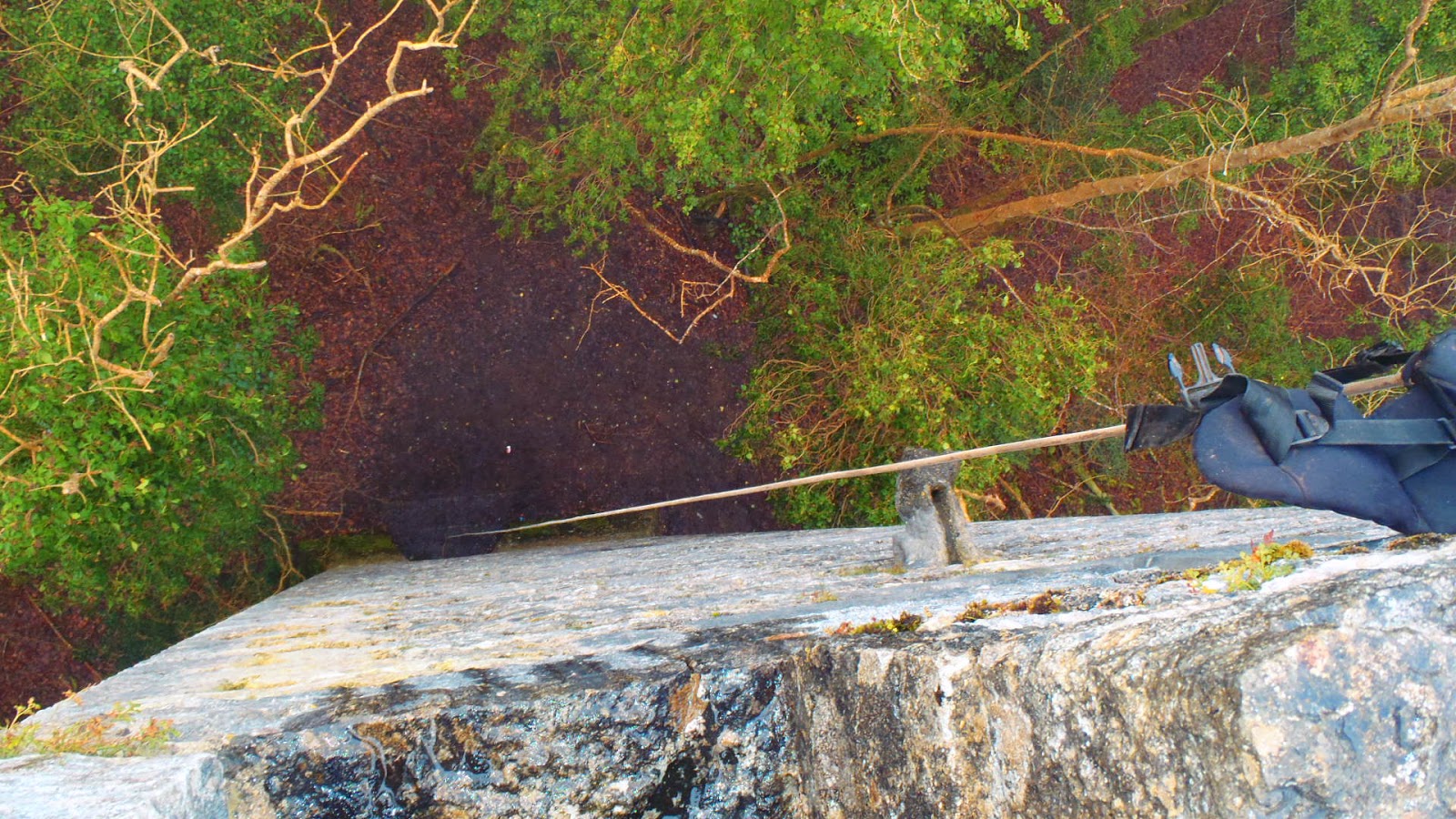
Brian got the bus started & defrosted and then we headed off to Cong to go abseiling on the tower which was built in A.D 1864 by Ben.L Guinness. It was built completely for recreational reasons, for locals to picnic in the summer etc.
I didn't realise how muddy it was going to be on this walk through the forest to the tower, & Brian told me I should be fine in runners... which unfortunately wasn't the case after the amount of rain we've had recently.

Luckily Emmet said he would carry me to save my runners getting ruined!
The plaque on the wall of the tower.

The Guinness tower was built in 1864 and is about 20m high. Not many people know about the tower, it is surrounded by tall trees which hide it even in winter. There are winding steps leading up to the top in a clockwise  direction. This was traditional with towers because most swordsmen would have been right handed and it meant that anybody coming up the stairs would have had to attack with their left hand but the men coming down the stairs would be able to defend with their strongest (right) hand.


First of all Brian set up the rope system at the top of the tower while we all watched how it was done. He then handed over another rope to us and we had to set up another system the same as his. I thought this was a good teaching strategy as it got us to learn by first watching him and then trying to do it ourselves. Fionan took leadership of setting up the rope system and we all gave a bit of an input as to what we thought should be done.
It was good to set up a rope system again because I hadn't set one up since my ML training last year and I was definitely a bit rusty.
The rope system set-up.

We then set up the belay system and I was the first person to belay while Dave was the first person to abseil down. I think he was nervous but he did really good. I gave him a bit of slack to get him started and then let the rope through slowly. I much preferred the belay through the carabiner than the belaying you have to learn for ML because it is so much easier through a carabiner than dragging ropes around your back! Plus, when it's on the carabiner there is much less pressure on you, in fact, you don't feel any pressure and you can feed the rope through swiftly and easily.
The view from the top of the tower.
Emmet went down next, it was his first time ever abseiling so he was very nervous. He did really good though and everybody was supporting him as he went over the edge. He needed a bit more instruction than those of us who had done it before, but once he got the hang of moving his right hand back and forth on the rope and trying not to hold on to any of the carabiners with his left hand, he was flying it. It was great to be able to help someone who hadn't abseiled before because when you have done it quite a bit, you sometimes forget how much of a big deal it is for someone who's doing it for the first time. Watching Emmet took me back to my first time abseiling, and when you first go over that edge at the top and you look down, it is quite daunting.


So Emmet did really well and really enjoyed his first time abseiling. Everybody had a go and then anybody that wanted to have another go, went again. I had good craic going down, it was a bit awkward getting going because we had a rucksack at the top to stop the ropes rubbing on the stone and causing fraying of the ropes and making them potentially dangerous. You normally use something like an old cut from a piece of carpet or something, just so it's not bulky and in the way. I went down fast and enjoyed bouncing out off the wall. It was the steps on the way up that were the killer! It felt like you'd never get back up to the top again! One way to keep fit!


After abseiling, we coiled a rope each and packed all the gear back into the rucksacks again before heading back to the centre for lunch.
Towards the end of our lunch, Brian came to sit with us all while we tried to make a plan for the afternoon. There was still no wind, so there was no point going out sailing. Eventually, we decided to just do a bit of launch and recovery of the dinghies with Peter and Dave who hadn't sailed as much before. So all the lads put on waders, (unfortunately there were none in myself and Liz' sizes!) and we went down to the dinghies. Liz & I put on buoyancy aids and were going to go in the powerboat with Brian.
Unfortunately, we couldn't go out on the water in the power boat because Brian couldn't find the key for the lock to take it off the pontoon.


The guys, loving their new gear!

The calm, foggy lake.

So we ended up just going down to the lake shore where Brian talked us through launch and recovery and a few bits about points of sail, when to turn head to wind and how to get home again if the wind is offshore.


Today was a bit of a funny day with the way the weather turned out for us. It reminded me of how you always have to be prepared with a back up plan in the outdoors. You have to make sure you always have a plan B incase the weather decides to play against you like it did today. Brian had to think on his feet and somehow give us a good day of outdoor activities even though we couldn't go sailing.


Environmental Interest of the Day...

Today while we were going up the tower, in all of the windows there were stalagmites and stalactites. These can only occur in certain pH conditions, often on limestone rock (which this tower is made of). The stalactite is above and hangs downwards like an icicle while the stalagmite is below and sticks up.
They grow in pairs, the slightly acidic water dissolves some of the limestone, carrying it downwards. When the water evaporates it leaves this structure where it appears the limestone has flowed downwards. Some of the water doesn't evaporate until the drip has fallen onto the surface below, causing the remaining limestone to build a stalagmite.
Often the stalagmite and stalactite will build up until they connect in the middle and this is then called a column.

Tuesday, 15 January 2013

15/01/13 - Orienteering - Moore Hall

15th January 2013

Orienteering - Moore Hall - Pauline
Dry - Sunny - 3*C

Today I was looking forward to going Orienteering because I hadn't been in a long time. I don't think I have been Orienteering since 1st year. So I was looking forward to getting out and remembering how to do it! Also, I have been running a lot more recently so I was looking forward to testing my fitness as I ran from control to control around the forest. I think it was a good idea to get everybody back together again.

First of all, Pauline explained to us what we would be doing and the different map options. We then had to go and set up the course, this was good to know how to do, especially for the people doing the orienteering instructorship with Kevin.

Stacy, Liz & I had to place controls near to each other's so we just went together to put our controls in place. We checked our pacing with each other because Stacy wanted to check & Liz needed to double check for her Orienteering map for Kevin's class. Then we placed Liz's control, it said it was over a stream, but there wasn't one. Everything else looked right, and there was no stream further up, so we just assumed that the stream was dry or something. We then jogged to my control and on to Stacy's control. We then walked the road back to the car park to start the timed competition.
Liz getting down a control.

I went first at 17minutes, Liz was right behind me, so we ended up doing it together. We had great craic running around trying to find the controls. It felt really good to be out in the fresh air with friends. Liz & I ran some and walked some. We didn't feel too pushed to run the whole thing.
Number 16 was very difficult to find and we met JT and Stacy around the same area looking for it too. We eventually found it but I think it had been placed in the wrong place. It just felt like it should have been in the depression further on...and everybody else's map skills told them the same.


Stamping my sheet. :)

Then it was just on to number 17 along the wall and Liz and I ran to the finish to get our time off Pauline. I think I did it in about 35 minutes. I'm not sure if that is a good or a bad time, but I felt good after the exercise, so I don't really mind where I came in comparison to everybody else!

Today was a good first activity day back after Christmas & New Year. It was fun & we all got to be together doing the same thing. When I heard that we had to set up the course as well as do the course, I was a bit bummed out. But that was just laziness talking! I actually enjoyed setting it up in the end. And then doing the course was good craic.


Brian & Martin on the course.

I hadn't done Orienteering since 1st year. In 1st year, I didn't enjoy Orienteering very much. This could be due to my lack of experience in map work and not really knowing what to do. However, it was interesting to see how I had improved in my map skills after my MS and ML1&2 training. It was amazing how much easier I found it and how much more I enjoyed it.
I wanted to do the second course, but we didn't have time to do both. Whereas last time I was orienteering, I couldn't wait for it to be over and when I got back I was hoping they wouldn't tell me to go again.
This shows that I have grown up and learnt a lot more as an individual since then.
I could feel the fitness that I have gained from running more recently. Since the new year I have been running every single day and when I started, I couldn't run for more than 2 minutes without stopping. Now I have managed to get that up to 15 minutes and the breaks that I need to catch my breath back are getting shorter and shorter. It feels really good. :)


Environmental Interest of the day...

Today I saw lots of Ivy growing around the forest floor and up trees. I think it was Hedera Helix. It is generally considered a vine but is actually a climbing shrub. It grows better in the shade during the juvenile stage because only the reproductive adult phase can tolerate high light conditions.
The berries for this Ivy are often used for tanning leather and dying textiles.